
Salary Negotiation: How to Confidently Ask for More and Win a Higher Offer
A few minutes of salary negotiation can shape your earnings for years, yet most people skip it entirely. With a clear plan and an AI salary negotiation coach to rehearse with, you can counter a job offer professionally and walk away with more money in your pocket.
The short version: negotiate only after you have a written offer, research your market range, counter roughly 10-20% above the first number, and back every request with the value you bring. According to a CareerBuilder survey announcement, 53% of employers say they are willing to negotiate salaries on initial job offers, so asking is the norm, not a risk.
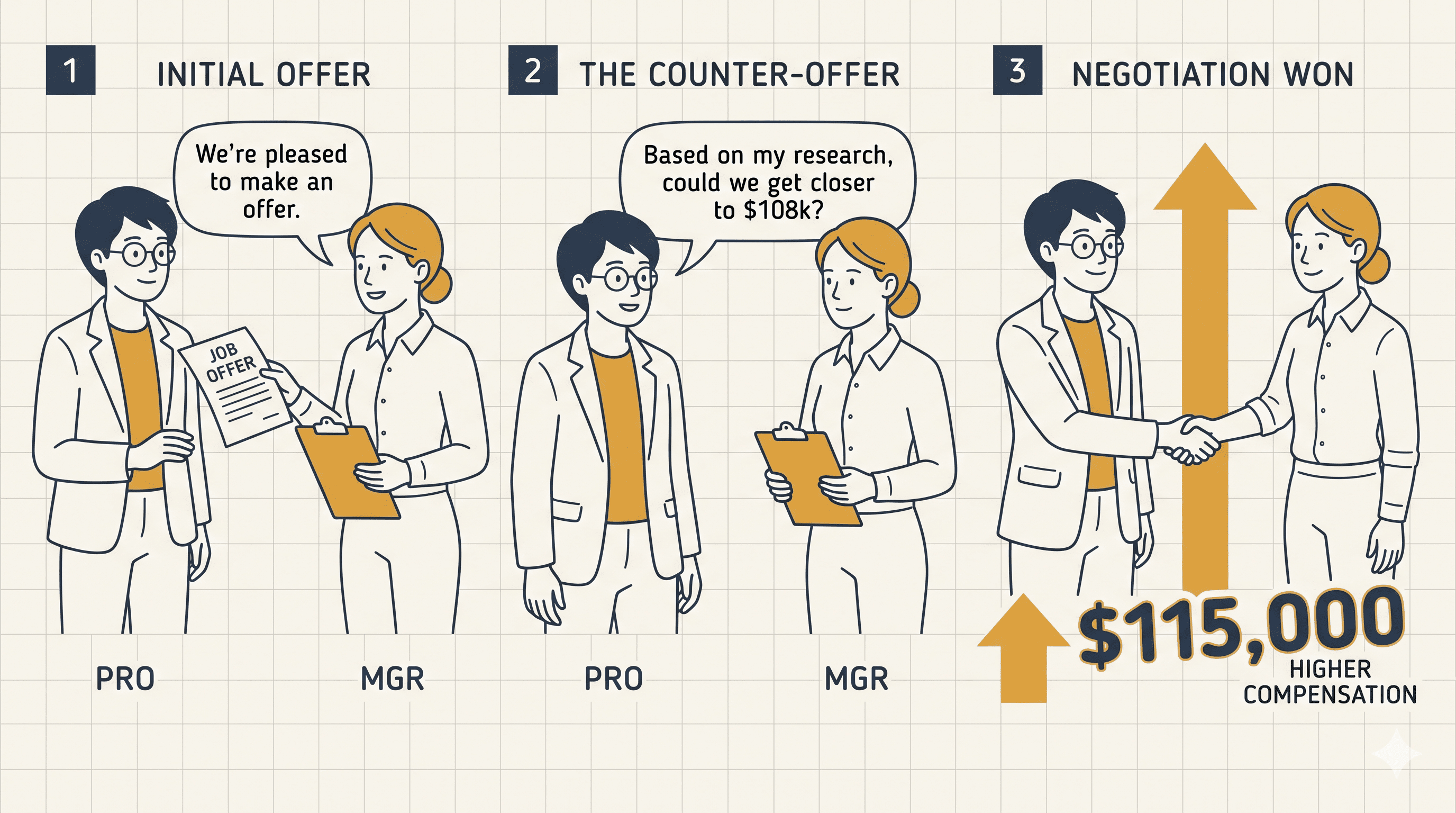
Why Salary Negotiation Is Worth the Discomfort
Negotiating pay feels awkward, but the people who push through that discomfort earn measurably more. The numbers show a clear gap between those who ask and those who accept the first offer without a word.
Most people leave money on the table
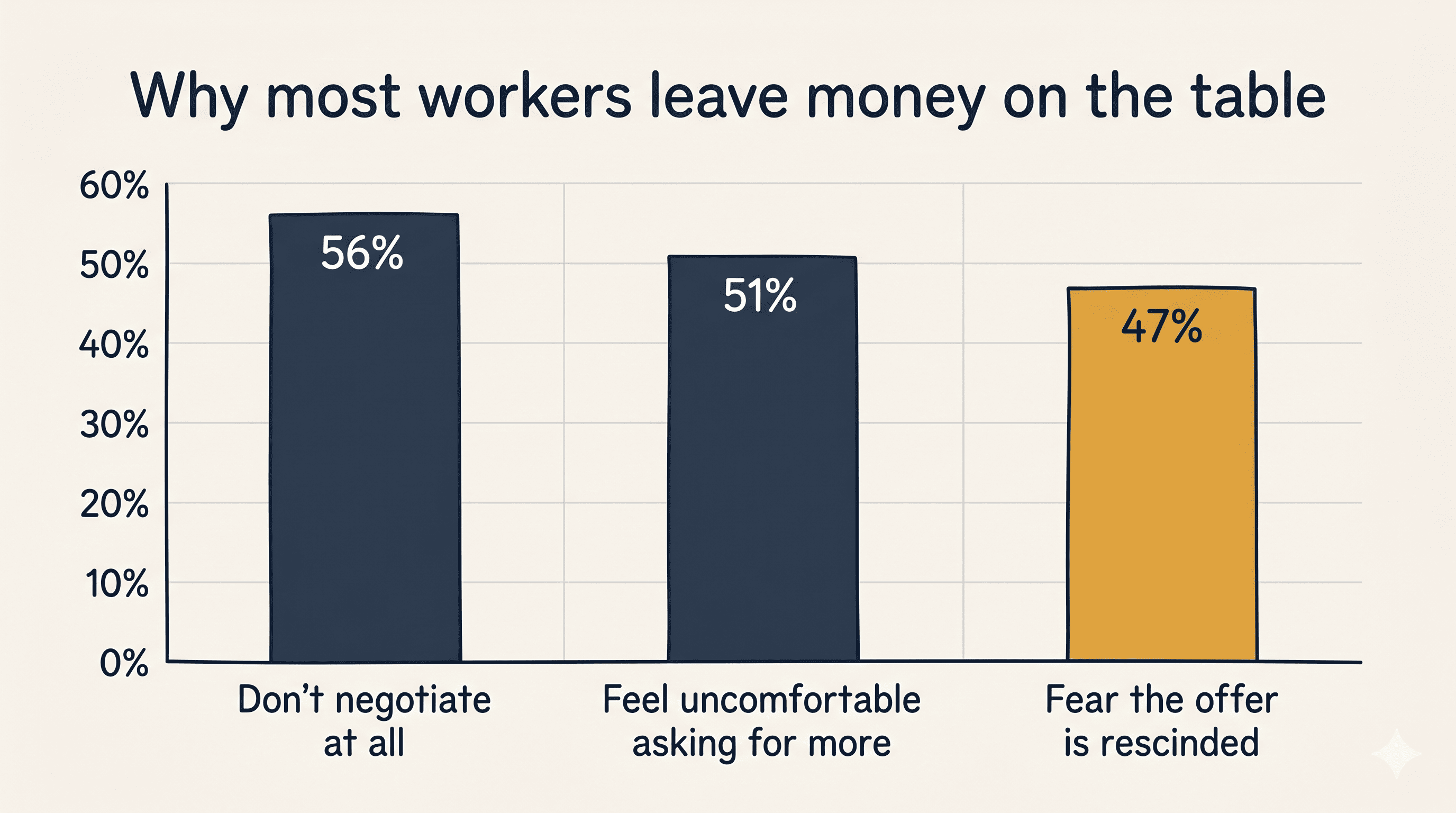
More than half of workers — 56% — do not negotiate for better pay when offered a job, according to CareerBuilder’s official survey announcement. The most common reasons are simple: 51% don’t feel comfortable asking for more money, and 47% fear the employer might decide not to hire them.
That hesitation is expensive. The first offer is rarely the best one a company is willing to make, so accepting it on the spot usually means surrendering money that was already on the table for the asking.
Employers expect — and reward — negotiation
Negotiating is not a gamble against the offer. The same CareerBuilder data shows that 53% of U.S. employers say they are willing to negotiate salaries on initial job offers, so the conversation is one many hiring managers already anticipate.
The upside is concrete, too. The Pew Research Center has found that when workers do ask for higher pay, a meaningful share succeed — and asking is the only way to find out, since employers rarely volunteer their best number first. Those who negotiate routinely end up earning more than those who accept the opening offer.
The most dangerous negotiation is the one you don’t know you’re in.
Chris Voss, author of “Never Split the Difference”
When to Negotiate: Timing and Leverage
Timing decides how much power you have. Negotiate at the wrong moment and you have nothing to trade; negotiate at the right one and the employer is motivated to keep you happy.
Wait for a written offer
Do not name a hard number before there is an offer on the table. If a recruiter asks early, deflect to a researched range or “the going market rate for this role.” It is fine to let the salary conversation begin during interviews, since most employers expect it, but firm commitments belong after the offer arrives in writing.
Getting the offer in writing protects you. It locks in the baseline you are negotiating from and gives you a document to reference when you present your counter.
Your leverage peaks before you accept
The window between receiving an offer and accepting it is when you hold the most leverage. The company has already chosen you, invested time in the process, and wants to close the deal, so this is the moment to ask. Once you accept, that leverage evaporates almost entirely.
Buy yourself room to think. Ask for 24 to 48 hours to review the full offer, and if the offer comes by phone, respond within a couple of days rather than reacting in the moment.
Do Your Research: Know Your Market Rate
A counteroffer without data is just a wish. Solid research turns “I’d like more” into “the market pays X for this role, and here’s why I’m at the top of that band.”
Build a defensible salary range
Combine industry data with company-specific data. For broad benchmarks, the U.S. Bureau of Labor Statistics Occupational Outlook Handbook lists median pay by occupation, and tools like Salary.com, Glassdoor, PayScale, and Levels.fyi narrow it down by company and level. On Levels.fyi, for example, entry-level software engineers at large tech firms often sit near six figures, while senior levels can be far higher.
Adjust the range for the factors that move pay: years of experience, leadership scope, education, certifications, and specialized skills. The goal is a number you can defend with a sentence, not a figure you pulled from the air.
Factor in cost of living and total comp
Geography reshapes every offer. A $90,000 salary in a low-cost city can outperform $110,000 in an expensive metro once rent, taxes, and daily costs are accounted for. Cost-of-living calculators help you compare offers across locations on equal footing.
Look at total compensation, not just base. Bonuses, equity, retirement matching, and benefits can swing the real value of an offer by tens of thousands of dollars.
How Much to Counter: The 10-20% Rule
Once you know your range, the next question is the actual number. Counter too low and you cap yourself; counter wildly high and you lose credibility.
Anchor high, but stay reasonable
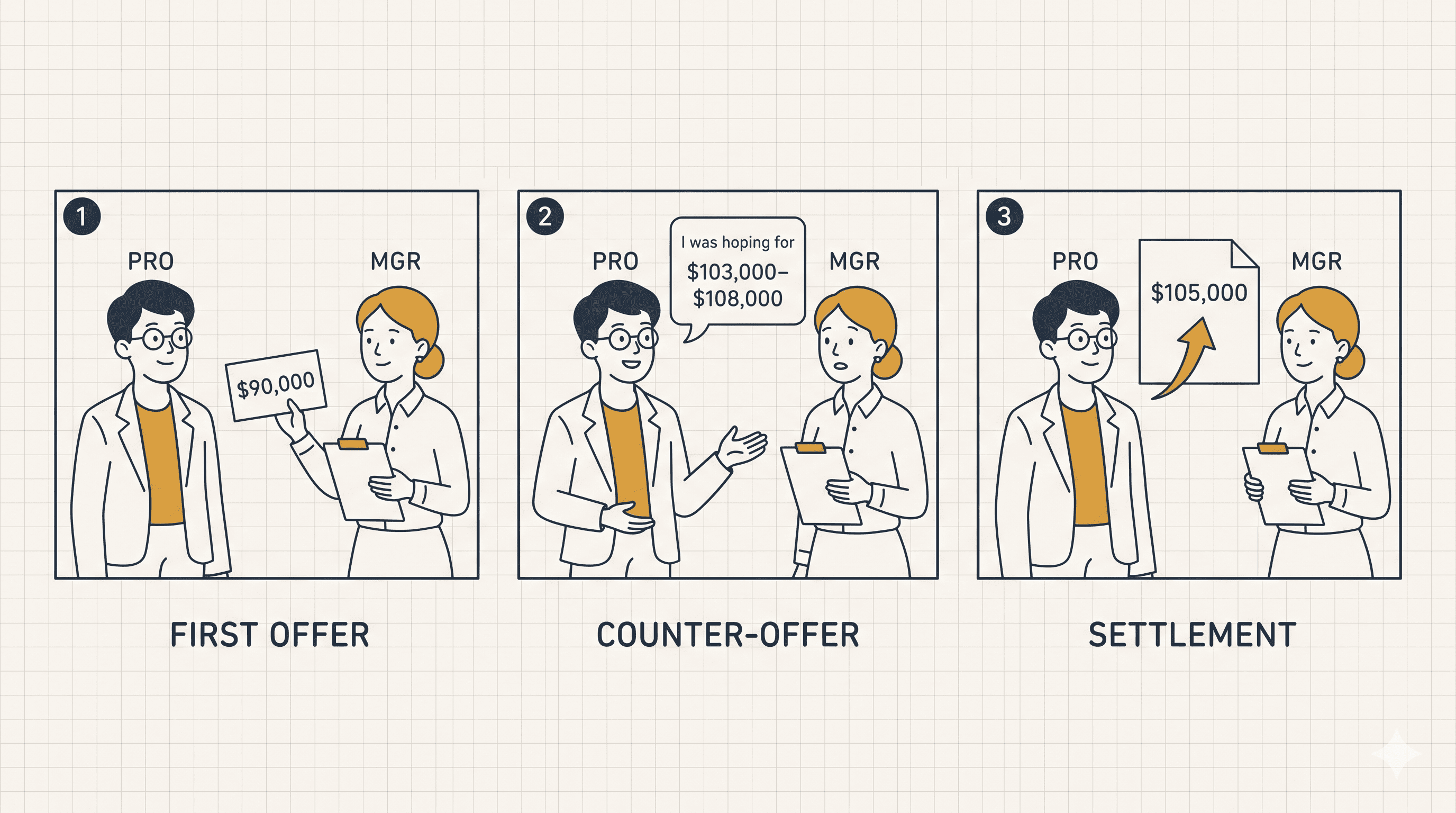
The standard move is to counter 10-20% above the initial offer, or a more modest 5-7% if the offer already lands mid-range for the role. So a $50,000 offer might prompt a counter in the $55,000-$60,000 range. This is anchoring: by naming a number near the top of your researched range, you pull the final agreement upward even if you settle somewhere in the middle.
Anchoring works because of the zone of possible agreement, or ZOPA — the overlap between what you’ll accept and what the employer will pay. Naming an ambitious but justified figure first shifts that zone in your direction. Just avoid the classic error of negotiating against yourself by lowering your number before the employer has even responded.
Counter once or twice — not endlessly
Treat the counter as a focused exchange, not a tug-of-war. Counter once, and if needed, once more, adding fresh justification each round rather than simply repeating a bigger number. Endless back-and-forth erodes goodwill and signals that no number will satisfy you.
Use this simple sequence when you’re ready to make your counter:
- Confirm the offer is in writing and thank the employer for it.
- Restate your enthusiasm for the role and the team.
- Present your researched counter as a specific figure or tight range.
- Justify it with one or two measurable accomplishments.
- Invite a conversation rather than issuing a demand.
- Ask for the revised offer in writing once you reach agreement.
What to Say: Scripts and a Sample Email
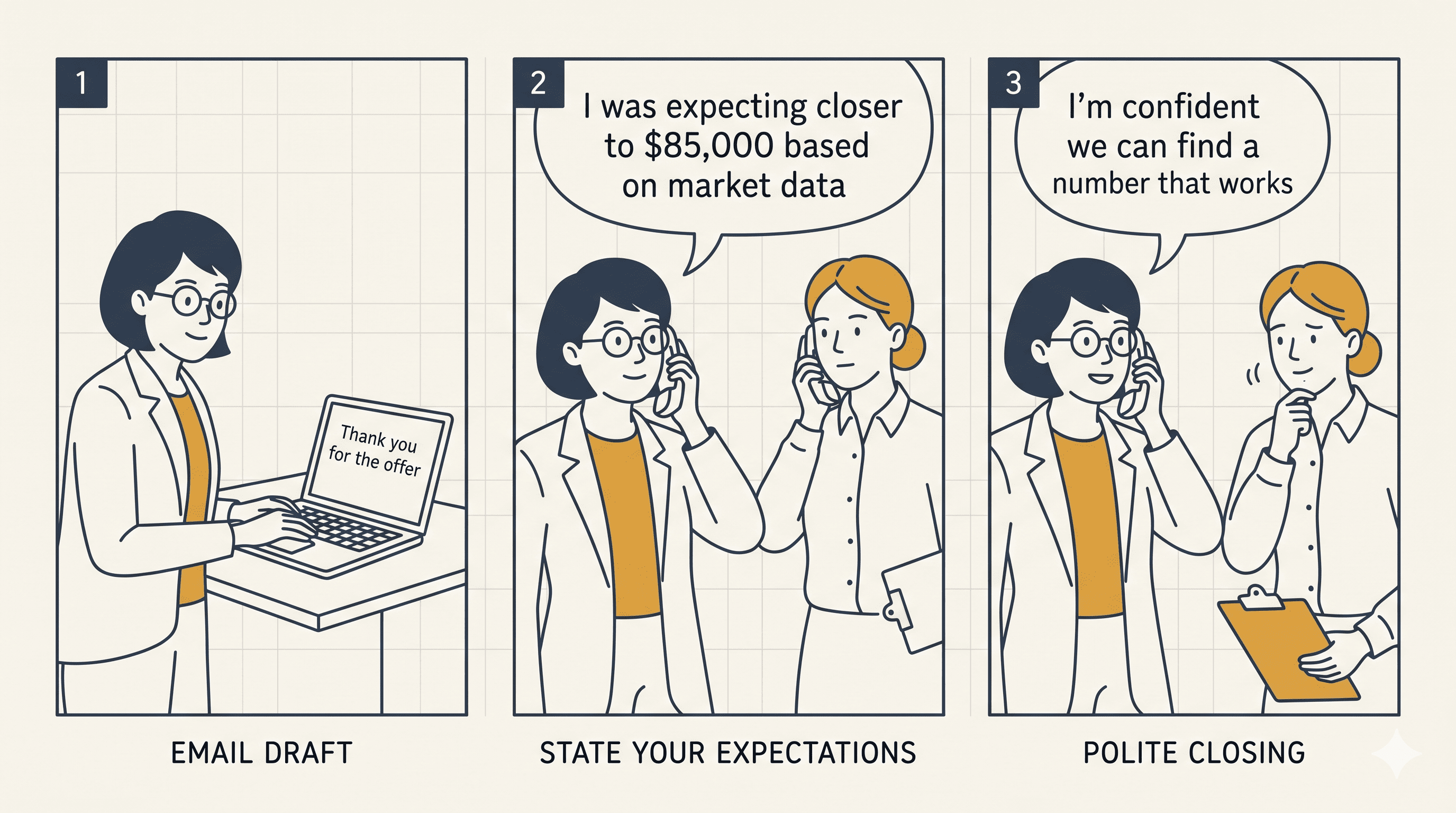
The right words make a counter feel collaborative instead of confrontational. Lead with gratitude, present your number, and let your track record do the convincing.
A counteroffer email template
A strong counteroffer email is short and confident. Thank the hiring manager, restate your excitement, present your researched figure, and justify it with concrete results. For instance, you might write that based on your research and your record — such as growing qualified leads by 40% in your last role — you’d like to land closer to $125,000-$130,000 rather than the $115,000 offered, and that you’re confident you’ll deliver similar impact for the team.
Keep the tone warm and professional throughout. You’re not making a threat; you’re opening a discussion that the employer already anticipated.
Rehearse before the call
Writing the script is only half the work. Practice delivering it out loud, anticipate pushback, and prepare calm responses to “that’s above our budget.” Rehearsal is exactly where an AI salary negotiation coach earns its keep, letting you role-play the conversation and refine your wording before it counts.
Negotiate More Than Base Salary
Base salary is only one lever. When the number won’t move, the rest of the package often will — and those pieces can be worth thousands.
Target the full compensation package. A complete offer includes signing bonus, equity or stock options, paid time off, relocation support, remote or flexible hours, retirement matching, and professional development. Non-salary benefits are frequently easier to negotiate than base pay, so they’re a smart fallback when the salary itself is capped.
Signing bonuses and equity are highly negotiable. Signing bonuses in particular often have room to move — candidates have doubled offered bonuses with a single short conversation. Equity is valuable too, but understand the vesting schedule before you count it, since stock typically pays out over several years rather than on day one.
Know when base pay is fixed. Some roles in government, unions, and academia follow rigid pay scales where base salary genuinely can’t change. In those cases, shift the entire negotiation toward start date, vacation, remote work, title, or a development budget.
The table below shows how compensation elements typically compare on flexibility:
| Compensation element | Typical flexibility | Best when |
|---|---|---|
| Base salary | Moderate | Private sector, before acceptance |
| Signing bonus | High | Base is near the top of band |
| Equity / stock options | Moderate-high | Tech and startups |
| Paid time off | High | Base salary is capped |
| Remote / flexible hours | High | Lifestyle matters most |
| Professional development | High | Early-career growth |
Common Salary Negotiation Mistakes to Avoid
Even well-prepared candidates undermine themselves with avoidable errors. Most of these mistakes share one root: making the conversation about you instead of your value.
The biggest pitfalls include accepting the offer on the spot, naming a number far too early, and justifying your request with personal expenses like rent or debt instead of the value you create. The guiding principle is direct: emphasize what you bring to the role, not what your bills require. Other traps include issuing ultimatums, negotiating over text message, and lying about competing offers, any of which can damage trust or backfire if the bluff is called.
| Mistake | Why it hurts | Do this instead |
|---|---|---|
| Accepting instantly | Surrenders your leverage | Ask for 24-48 hours |
| Citing personal expenses | Shifts focus off your value | Cite market data and results |
| Giving an ultimatum | Sounds adversarial | Frame it as a collaborative ask |
| Negotiating by text | Feels casual and weak | Use email, phone, or in person |
| Bluffing other offers | Backfires if called | Be honest about your position |
Frequently Asked Questions
- How do you politely negotiate salary?
Lead with gratitude and genuine enthusiasm for the role, present a researched figure, and back it with one or two specific accomplishments. Keep the tone collaborative rather than combative, and frame it as a discussion, not a demand.
- How much should you counter on a salary offer?
A common guideline is to counter 10-20% above the initial offer, or 5-7% if the offer already sits mid-range for the role. Anchor your number near the top of your researched market range so the final figure lands where you want it.
- Can a job offer be rescinded if you negotiate?
It is rare. Many employers anticipate negotiation, and 53% say they are willing to negotiate salaries on initial job offers (CareerBuilder), so a polite, reasonable counter almost never costs you the job. Stay professional and the risk stays very low.
- When is the best time to negotiate salary?
After you receive a written offer and before you accept it. That window is when your leverage is highest, because the employer has chosen you but you have not yet committed.
- What should you not say when negotiating salary?
Avoid revealing your current pay too early, citing personal expenses like rent or debt, issuing ultimatums, or accepting on the spot. Keep the focus on market data and the value you bring to the role.
- Is it OK to negotiate non-salary benefits instead?
Yes. When base pay is fixed, items like paid time off, remote work, a signing bonus, equity, and professional development are often easier to negotiate than base salary, making them a smart fallback when the number itself cannot move.